
The Talent Utility Curve: What is it & why do recruiters fail to climb it?

The best compliment that a recruiter can receive is, "I can't believe you're a recruiter."
Sometimes this is amended with just by saying, "I can't believe you're just a recruiter," and other times people dish out the compliment via softer probing questions along the lines of, "Wait, what's your background?" or "What'd you do prior to recruiting for Company X?"
While it is amazing to receive the compliment, either directly or indirectly, it's also puzzling.
Is it wrong to be just a recruiter? Or is it a waste of talent to be just a recruiter?
I don't think so. It's a real privilege to be a recruiter, even if just that.
Talent Acquisition as a Credibility Engine
Marc Andreessen -- co-founder of a16z, one of the world's leading VC firms -- said the following about venture capital:
A top-tier VC is a bridge loan of credibility at a point in time when a startup maybe deserves it, but just doesn't have it yet.
I think about that quote a lot, and feel that it can be easily applied to talent acquisition, especially when it comes to recruiting top-tier talent:
A top-tier recruiter is a bridge loan of credibility at a point in time when a vision maybe deserves it, but just doesn't have it yet.
The vision? A transformation. Just doesn't have it yet? Talent Market Fit. And who needs this bridge loan of credibility? Any company that is in the business of transformation: startups who are transforming industries, functions, or both; PE firms who are transforming PortCos; and enterprises who are transforming themselves.
If talent acquisition is the function that goes to market to persuade candidates to buy into your vision, then recruiting, therefore, is a go-to-market (GTM) motion. Yet despite recruiting being a GTM motion, I have a sneaking suspicion that most companies would not trust their recruiters to build & execute against their GTM strategies.
That's gravely problematic, especially if talent acquisition is expected to be a bridge loan of credibility for recruiting top-tier talent.
And why is it that most companies wouldn't trust recruiters to lead their GTM efforts?
It's because most recruiters fail to climb what I call the Talent Utility Curve.
The Talent Utility Curve
The Talent Utility Curve is a visualization that maps out how well a recruiter understands the company it is recruiting for against the potential value that a hired candidate could provide at that given company.

The X-Axis: this axis represents the depth of understanding that a candidate has of a company. Further left on the axis are shallower "check the box" questions such as the what's and the who's; further right on the axis are deeper "value maximization" questions, such as the how's and the why's.
The Y-Axis: this axis represents the potential value multiple that a candidate could provide at a company. Lower on the axis are value maintainers, in which the potential variance in value is both minimal and predictable because Talent Market Fit is high. When Talent Market Fit is high, then there is a clear articulation of roles, responsibilities, & playbooks that mitigates the risk of value detractors while also maximizing output. Higher on the y-axis are value creators, in which the potential variance in value is both high and difficult to predict because Talent Market Fit is low. When Talent Market Fit is low, teams may potentially experience a high variance of value because they are rapidly iterating on tradeoffs.
If Talent Market Fit is high, then it's likely that candidates may only need to understand the what and the who in order to be successful in a role at a company. When this is the case, then talent is a commodity and recruiting is a vendor for both finding & delivering such talent.
Conversely, if Talent Market Fit is low, then it's imperative that candidates understand the how and potentially the why to be successful at a company. Recruiting, then, is a partner for identifying, engaging, selling, & assessing talent, as talent is expected to provide outsized value at the company.
As such, it is in scenarios when Talent Market Fit is low that the right hire can be rocket fuel. And the wrong hire? Well that can be a potential catalyst for an explosion.
The Importance of Company Storyboarding
Company storyboarding is a critical component for climbing up the Talent Utility Curve.
In short, the how tests for managerial capabilities: how one can get the most output from existing inputs (e.g. aligning team members to value drivers, building incentive structures, nurturing a culture of accountability & empowerment, etc).
The why, on the other hand, tests for leadership capabilities: how one evaluates tradeoffs when it comes to making nontrivial decisions that both minimize risk & maximize value and then builds consensus around those decisions to turn inertia into momentum.
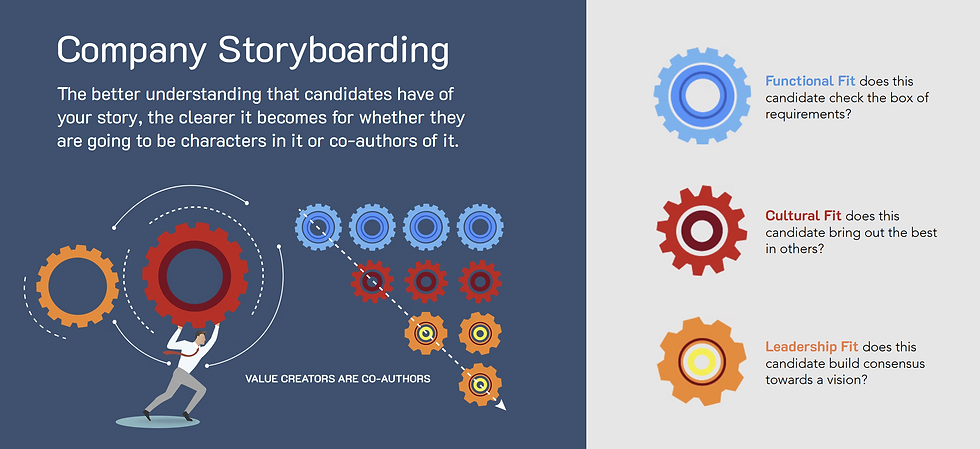
To put it rather bluntly, not every manager can be a leader, but every leader can be a manager. This is because leaders are co-authors, not just participants, of the stories that they help companies write. And to be better co-authors, leaders need to not just understand character development but also the skeletal plot line, even if the ending of the story hasn't been fully fleshed out yet.
Below is a progressive question grid that shows the depth of questions that candidates may ask that interviewers therefore can use to assess different levels of fit. Questions in blue assess functional fit (does this candidate check the box of requirements?), questions in red assess cultural fit (does this candidate bring out the best in others?), and questions in orange assess leadership fit (does this candidate build consensus towards a vision?).

The deeper that one moves into the question grid, the more important that inferential questioning becomes. Whereas the blue tiles can be asked via a more-pointed approach leading to clear-cut answers, the red tiles start to focus on aptitude.
Is the candidate asking the right questions to demonstrate strong intellectual curiosity?
Is the candidate asking thoughtful questions that indicate (s)he'll be able to navigate political nuance?
Is the candidate asking pragmatic questions to methodically uncover potential risks, ultimately revealing how past battlescars may signal confidence to the interviewer that when things get hard, the candidate will be tenacious & buckle down as opposed to shying away from challenges?
Is the candidate thinking holistically by asking questions to help them connect the dots among team members with whom they'd work, to neighboring functions to the one they'd call home, & across the company as a whole?
Whereas the red tiles can help uncover some great managers, the magic really starts to happen when one can confidently navigate from the red tiles to the orange tiles. This is best done via inferential questioning and accomplished by what I call the reverse-Thiel method.
The Reverse-Thiel Method for Inferential Questioning
Peter Thiel is famous for a lot of things, from being one of the co-founders of PayPal to founding the Thiel Fellowship. He also wrote the book Zero to One: Notes on Startups, or How to Build the Future in which he discusses his favorite interview question:
What important truth do very few people agree with you on?
The goal of the question is two-fold. First, does a candidate display enough courage to share an "against the grain" perspective? And second, is the candidate able to articulate an original thought that isn't one of consensus?
Whereas I love the question, I struggle with answering it myself. Because of that, I find the question is one that is more fun to tease out at a dinner party as opposed to one that is more useful to serve up in an interview. That said, I do think there is a fantastic opportunity for companies to reverse-Thiel candidates when they interview them.
What is reverse-Thieling?
Reverse-Thieling is when companies share an important truth with candidates that very few other companies agree with. Doing such has two main benefits. First, sharing an "against the grain" perspective sheds light into the "why" behind a build journey. In other words, sharing the "why" provides intentionality of a build or rebuild. Second, having the company articulate an original thought that isn't one of consensus gives it an edge of differentiation from the competition.
When one reverse-Thiels, it requires the ability to sense & react. This is hard to do, but it usually plays out in the following order of operations.
An interviewer shares an important truth of the company with a candidate. Typically, the more provocative a truth is, the better this works.
Then the interviewer senses how the candidate is processing the important truth.
Finally, the interviewer reacts to how the candidate is processing the important truth to tee up a new line of inquiry to further build upon the conversation.
Most companies are not great at doing this, but the ones who do it well have an incredible advantage when it comes to hiring best-in-class talent. This is because reinforcing the why aligns clarity with intentionality, and doing such demonstrates to candidates the impact that they could have at that company. Purpose is a powerful thing.
Some examples of companies I've worked with in the past who were great at reverse-Thieling include:
A biotech value creation platform that believes governance issues are the leading cause of biotech failures. This is a stark contrast from the widely-held belief that most biotechs fail because the science failed.
An AI-powered org diagnostic for PE firms & PortCos that believes the most consequential variable in a PE deal is usually the least objectively measured: human capital.
What's interesting about reverse-Thieling is that great candidates do not have to agree with a company's important truth.
If candidates do agree with the important truth, then they should use that truth to dive deeper into the why's behind your company, such as, "This feels so obvious now that you shared that with me. So why aren't other companies doing this, too?" Thematically I've found that candidates who tend to go broader instead of deeper with their questioning usually won't be a good fit from a leadership lens perspective. And it's when candidates go deeper with their inquiries that one is able to test their critical reasoning in real-time and assess how they may connect the dots across previously-disparate pieces. A way to do that by answering the above question is to run them through a thought exercise: "Well, lets play this out in real-time, because I'm curious to get your perspectives. You mentioned that this feels obvious, so why don't you think more companies are doing this in the way that we're doing it?"
If candidates do not agree with the important truth, then they should be sound in their reasoning as to why that is. In these situations, candidates not agreeing with a company's important truth gives the interviewer an opportunity to interrogate that reasoning, leveraging his/her own company's use-cases of how value has been uniquely created by the company as evidence that attacks the candidate's viewpoint. Thematically I've found that candidates who waver too quickly on their viewpoint to conform with that of the company's or candidates who do not have strong evidence to support their truths (e.g. doing it as an act of baseless stubbornness) are ones who won't be strong leaders. That said, I've found that candidates who are strong in their reasoning for why they don't agree with a company's important truth are worth interviewing, as it's not a zero-sum game. Perhaps the perspectives that those candidates share with an interviewer force a company to reexamine its truths or alter some assumptions. Or perhaps the company is able to convert the contradictory candidate into a believer.
Regardless of the outcome, either result is an iterative exercise for a company to improve its narrative. And that's a win, if you ask me.
Final Thoughts
Recruiting could soon have its Renaissance moment, and in a world that's being eaten up by software & AI, I don't mean this moment to be a reflection of either of those things. Rather, I think recruiting could level up to be an enterprise value driver at many companies in this new era of value creation.
For that to happen, though, recruiting has to level itself up. We've become complacent as a function if we only settle for the what's and the who's.
As talent stewards for the brands that we serve, we need to be hungry to climb up the Talent Utility Curve to not just understand the what's and the who's, but also the how's and the why's. We need to earn the right of the stakeholders with whom we work so that they can say with overwhelming confidence, "I'd trust recruiting to lead our company's GTM efforts."
Doing such will empower us to become better storytellers. Doing such will help us become better interviewers. Doing such will allow us to have more meaningful "move-the-needle" conversations with both hiring managers and candidates alike.
And doing such will mean that being just a recruiter is a real privilege.


Comments